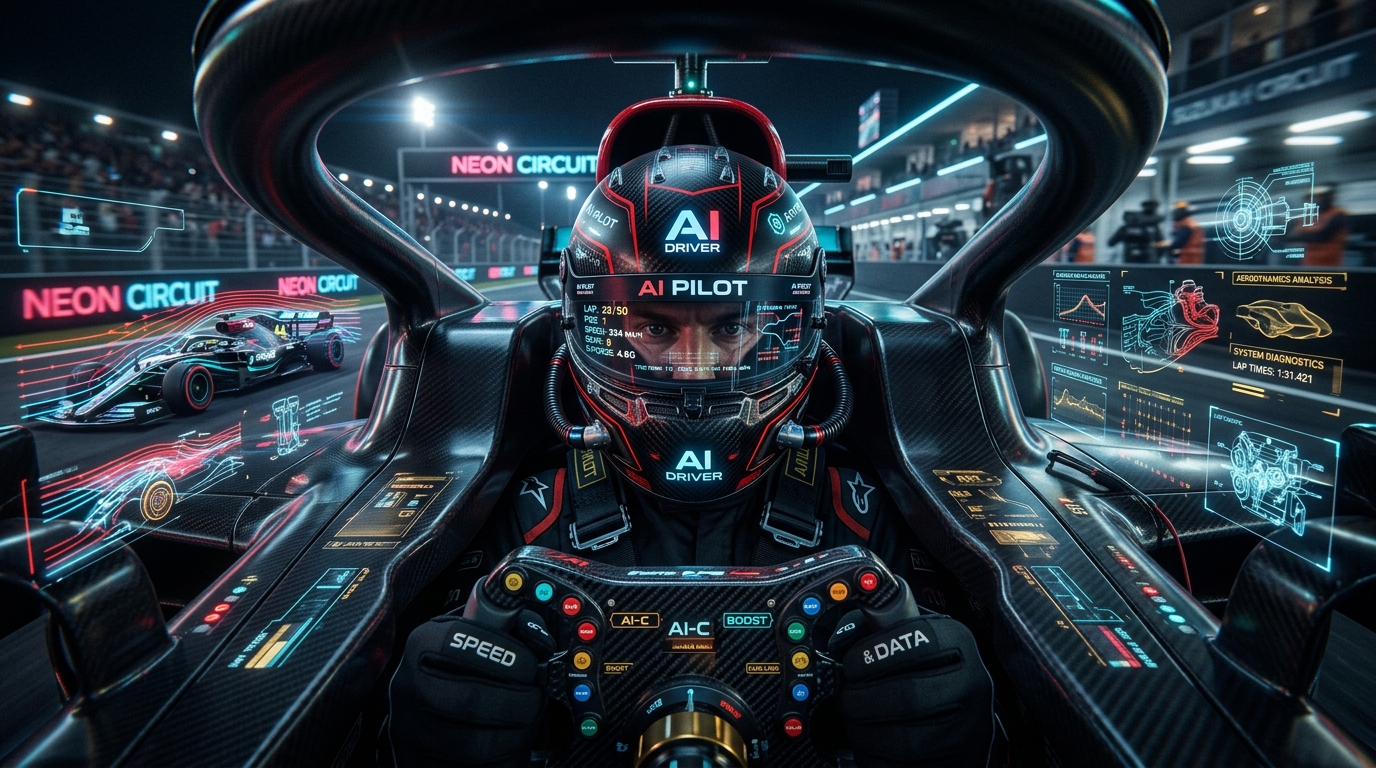
"Niki Lauda was not just a fast driver—he fundamentally redefined what it meant to be a professional Formula 1 driver. While most of his 1970s peers relied on raw instincts, bravado, and natural talent, Lauda brought clinical precision, scientific analysis, and unmatched mental toughness to motorsport."
— The Delivery Pilot Standard
🔧
1. Technical Mastery Over Emotion
Where ordinary drivers treated the car like a wild horse to tame, Lauda treated it like a machine to engineer. He was famous for giving engineers brutally honest, granular feedback—telling Ferrari their car was "a piece of junk" during early test drives until they fixed its handling. He understood mechanics better than almost anyone on the grid, enabling him to set up a chassis to maximize efficiency over an entire race distance rather than just one heroic lap.
🤖 The Delivery Pilot Reality
Casual developers treat LLMs like magical black boxes and hope for a good response. A Certified Delivery Pilot understands context windows, token telemetry, latency limits, MCP tool boundaries, and deterministic verification. They don't just "prompt"—they engineer the entire execution harness.
🛡️
2. Clinical Risk Management
Most drivers in his era were romantic thrill-seekers who accepted the deadly risks of 1970s racing. Lauda was pure logic. He famously said he was paid to drive, not to take unnecessary risks. When conditions became life-threatening at the rainy Japanese Grand Prix in 1976—just months after surviving a fiery crash—he pulled into the pits and retired, stating his life was worth more than a title.
🔒 The Delivery Pilot Reality
Hobbyist coders blindly deploy autonomous agents into production with unbounded write permissions. A Delivery Pilot applies Zero-Trust AI perimeters, strict rate-limiting, rollback mechanisms, and air-gapped sandboxes. They know exactly when an agent's confidence score dips below threshold and when to hand over control.
🧠
3. Psychological Resilience
Lauda's comeback after his famous 1976 Nürburgring crash is considered one of the most unbelievable feats in sports history. Trapped in a burning car, he suffered severe third-degree burns to his head and inhaled deadly toxic fumes. Just six weeks later—with fresh skin grafts and bloody bandages under his helmet—he was back behind the wheel at Monza finishing 4th, overcoming intense pain and mental trauma through pure willpower.
⚙️ The Delivery Pilot Reality
In complex enterprise migrations, AI agents hallucinate, APIs break, and legacy systems push back with massive technical debt. A Delivery Pilot possesses the grit and structural discipline to debug regressions, rebuild state machines, refactor brittle tests, and drive projects across the finish line regardless of turbulence.
🔄
4. Adaptability Across Eras
Average drivers rely on a specific driving style, but Lauda adapted as the sport evolved. In the 1970s, he dominated through raw speed and technical setup. Returning in the 1980s with McLaren, he realized his younger teammate Alain Prost had a slight edge in raw qualifying pace. Lauda adapted by focusing entirely on race setup, tire management, and strategy—ultimately beating Prost to win the 1984 World Championship by half a point.
📈 The Delivery Pilot Reality
Yesterday was syntax memorization; today is single-agent prompting; tomorrow is autonomous multi-agent orchestration (BMAD, LangGraph, Claude Code). A Delivery Pilot continuously upskills, pivots architecture models, and optimizes strategy to deliver perpetual business advantage.
🏆 Continuous Vetting & Credentials
Why Certification and Continuous Vetting Matter
In Formula 1, putting an unvetted driver in a 1,000-horsepower machine guarantees a catastrophe. In the enterprise, handing unvetted AI tools to untrained personnel produces security leaks, architectural drift, and silent failure. Delivery Pilots are certified and constantly vetted professionals trained to operate autonomous AI systems with military precision.
🔍 GitHub-Verified Repositories
No theoretical CV claims. Every Delivery Pilot maintains public, verifiable code showing real commits, test suites, and production agents.
📜 Proctored Vendor Accreditations
Holding industry-standard certifications (Anthropic, Microsoft Azure AI, Pearson VUE) backed by continuous recertification cycles.
🛡️ Zero-Trust Security Clearance
Trained in strict data boundaries, NATO/SC-cleared security principles, GDPR compliance, and enterprise guardrails.
⚡ Live Simulation Audits
Undergoing weekly unscripted screen-share stress tests to debug regressions, resolve agent deadlocks, and optimize telemetry.